
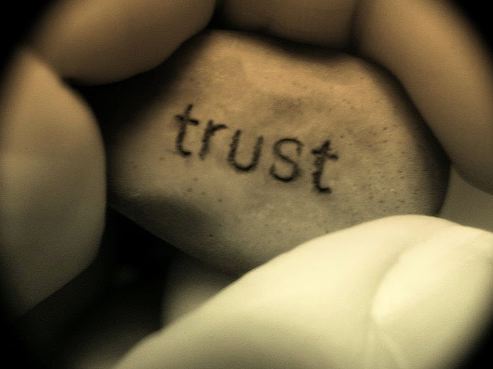
Trust me. It’s critical to sustainable success.
In 2009, “hope” may be the buzz word, but “skepticism” is the reality. With daily surprise lay-off announcements and entire industries under scrutiny and/or bankruptcy, employees and employers alike are hunkering down and preparing for the worst. The by-product is low trust, secrecy and less communication. Not surprisingly, this creates low morale resulting in less productivity and, ultimately lower profits.
The good news? For companies, this is the perfect opportunity to set themselves apart from the competition and create a high trust work environment, which will reap the advantages of attracting and retaining top talent as well as customer confidence in the process. For employees, it is an opportunity to make a real difference in their work environment and help them create an individual path to success.
Let’s first look at how “trust” is defined. Author, Stephen M.R. Covey describes trust succinctly utilizing four core elements, in his book, The Speed of Trust:
Character:
Core 1 – Integrity (courage to act in accordance with your values and beliefs)
Core 2 – Intent (motives, agendas and resulting behavior)
Competence:
Core 3- Capabilities (talents, attitudes, skills, knowledge, and style)
Core 4 – Results (track record, performance, getting the right things done)
Think for a moment about an employer, supervisor, co-worker, or employee that you just didn’t trust or perhaps betrayed your trust. Was it character or competence that led you to your decision? Or, both? The answer(s) will help define “trust” for you on a much more personal level.
“Low-trust organizations are characterized by manipulation, secrecy and the triumph of shrewd calculation over hard work. High-trust organizations, on the other hand, are rewarded with a culture that supports creativity and collaboration among its members,” write Don Cohen and Laurence Prusak in, In Good Company.
How Leaders Build Trust
The rewards of a high trust environment are clear. But attaining trust requires time, attention, and work. For example, you may have stellar credentials and have led many successful teams in the past, but the new team you were just hired to lead needs to learn who YOU are before they will truly trust you. They need to understand your character and motivations.
In our fast paced world, are there any shortcuts to this process? Not really. And, when you try and take the fast track you risk harming your reputation. Be Patient.
The following are 8 trust building ideas (nice even number):
- Consistently observe your own motives (think “win/win”) Ask yourself: Am I interested in growing my team professionally? Am I looking for win/win solutions in all my relationships?
2. Communicate with candor (tactfully/respectfully) Jack Welch dedicated an entire chapter in his book, Winning, to this very subject.
3. Don’t use Truth as a weapon (overuse or misuse of the “truth” will not win trust) Look at your motive when revealing information. Are you betraying a confidence? What purpose will it serve to share this “truth”?
4. Avoid passive/aggressive behavior (yikes!) You know who you are. This behavior is definitely a trust killer!
5. Give credit (always!) Do not ever take credit for others work, ideas, or efforts. If want to build a dynamic, effective group, identify team members efforts and publicly praise them, frequently.
6. Set CLEAR Expectations (be specific and realistic) The most trusted and effective leaders set clear expectations for their team and hold people accountable for results.
7. Communicate, communicate and communicate some more (listen!) It’s important to hear what your team is saying. Keep your ear to the ground and hear the musings and rumblings as well. A smart leader will address issues and dispel rumors openly, as well as, allow for two-way communication.
8. Honor others in their absence (don’t gossip!) Successful leaders don’t gossip. If you are in a position of leadership, you have a responsibility to be honorable and address issues directly. A sure way to lose respect along with trust is to gossip.
Assess Yourself:
The Speed of Trust online assessment will help you to identify your credibility with others and a test on whether you practice the 13 trust behaviors or their more common counterfeits :
http://www.speedoftrust.com/email.php
The Trust Leader online Leadership assessment is a starting point to becoming a trusted leader: http://www.thetrustedleader.com/test.html
How Employees Can Build Trust
So, you come to work every day and hide behind your desk. You are miserable, because the “company/leader/boss” [you fill in the blank] does not keep you informed! They are so secretive. You just know something bad is about to go down. You plan to stay below the radar and keep plugging along. You know who I’m talking about. I’ve been there too! Trust is a two-way street. As an employee, you have responsibility in a low trust relationship.
Below are 8 trust building ideas you can utilize for success:
- Contribution (adding value to the team/company) Ask yourself: Am I truly adding value to the organization? If not, what clarifying questions, support, tools do I need to be successful? Once you have the answer – ask for what you need!
2. Communicate with candor (tactfully/respectfully) Be cautious. Too much candor can lead to termination, if you are not careful. Adjust your style to your supervisor – start slowly and increase speed, if well taken.
3. Don’t Tattle (no one likes a tattle tale!) This is not building trust, actually destroys camaraderie and trust. Check your motives – if it violates policy or the law, you may not have a choice, but if your co-worker shows up 10 minutes late, don’t run to your supervisor!
4. Avoid passive/aggressive behavior (yikes!) Again, if there are issues that are bothering you, address them immediately. Don’t be the powder keg that explodes because there is no creamer left in the kitchen. Truly, this behavior is definitely a trust killer with both your co-workers and supervisor.
5. Give credit (always!) Like with supervisors, you should never take credit for others work, ideas, or efforts. Giving credit to fellow team members for their work will help you build camaraderie with your team members as well as earn you respect from your supervisor.
6. Deliver Results (be specific and realistic) Set achievable expectations and deliver quality, on time, results. If you miss a deadline, don’t give excuses! Apologize for not meeting the expectations and figure out how you can meet the set objectives in the future. Remember, successful people make mistakes, but what differentiates them from unsuccessful people is they have integrity, take responsibility for their actions and make sure they figure out how to deliver in the future.
7. Communicate, communicate and communicate some more (listen!) It’s important to hear what others are saying (including your co-workers and supervisor). If you need more information, ask. If you have a question, ask. If you don’t understand the objective, ask. Asking questions, the right questions, is critical to your future success. - Honor others in their absence (don’t gossip!) This is so hard to do, especially in a low trust environment. But, please resist the temptation. I understand that your boss or co-worker may drive you nuts, but see if there is a better way to relieve your frustration. Maybe change your perspective and address the issue directly with the person. It’s your first step in becoming a leader yourself and making a real change.
Excellent article by John. This is advice we all need to heed.
Great article and ideas!